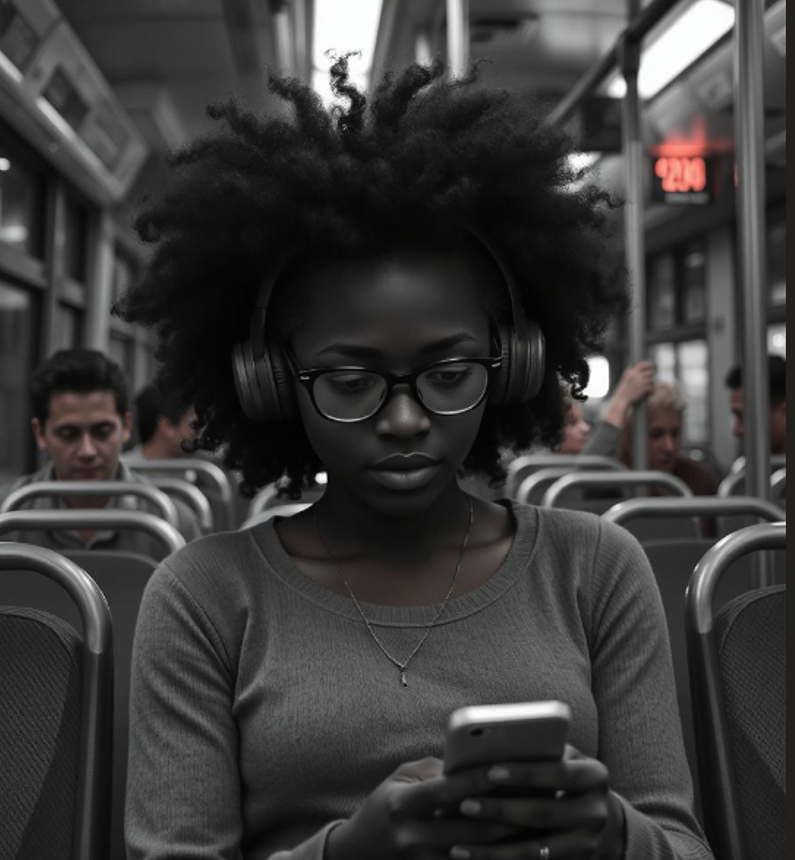
Life 1 — Midnight
Chapter One: Midnight: The Girl Who Listened for Footsteps
Midnight, they named her , and she lived up to it.
Her skin was as dark as the hour when the world grows quiet, and only her eyes and her smile seemed to glow against it. When she laughed, her teeth lit up her face, a soft defiance against the darkness that people so often misunderstood.
Strangers assumed she must be from East Africa, yet her skin did not carry the same undertones. Others said she could not be from the southern coast either , she was too dark, too different, too difficult to place. But she was born there, raised there, and still she felt like an outsider in her own home.
Both her parents came from the south-east coast, born and bred in its salt winds and familiar rhythms. Yet when her mother turned eighteen, she ran , hoping for a better life, hoping to escape the limits of where she came from. In doing so, Midnight inherited not only a new life, but a broken map of identity.
She grew up wondering where she belonged.
Too dark for the south.
Too unfamiliar for the south-east.
Her tongue did not sound quite right anywhere.
The words that left her mouth felt strange to others, like they carried echoes of places she had never fully lived in. People welcomed her , but never fully claimed her. They smiled, but still searched her face for clues about where she truly came from.
In the south, she was a wanderer in her own birthplace. Everywhere she went, she sensed their silent questions:
Where are you really from?
Skin too dark.
Voice too soft.
Neither here nor there.
And so Midnight learned to move through the world half-seen, half-known, always wondering if belonging was something she would ever truly find.
The bus rattled like it was tired too.
Midnight sat by the window, earbuds buried deep, music turned up so loud that the city dissolved into moving shadows. Streetlights stretched across the glass, yellow and trembling, and strangers leaned into one another the way people do when the day has drained them.
She pressed her forehead to the window. It was cold. Steady. Real.
In this small space, no one could reach her.
Her shoulders carried a job that paid the bills but not her spirit, a job that kept her family afloat and her heart heavy. Breadwinner, they called her. A proud word that felt like a weight.
Her hands rested in her lap, rough from work, nails bitten low from thinking too much. She looked distant, almost peaceful, but beneath the music there was a hum in her chest , a quiet tension that had been there far longer than this day.
The bus hit a pothole.
The sound cracked through her like thunder.
For a moment, the present slipped.
She was no longer on a bus.
She was eight years old again, sitting under a wooden table while the floor above her shook with footsteps she could not control. The air smelled faintly of alcohol and smoke, and the house felt too small for the noise inside it.
She remembered holding her breath so hard her chest hurt, counting seconds the way children do when they’re trying to survive without moving.
A door slammed.
The memory snapped back.
The bus swayed. A child laughed across the aisle. Someone argued quietly about money behind her.
Midnight swallowed.
She turned the music louder.
When the bus slowed at her stop, she didn’t stand immediately. She waited , as if stepping off too quickly might pull the past with her.
Outside, the night felt thicker than the day.
She walked home with the bass still thumping in her ears, pretending that if the volume was high enough, the house from her childhood would stay buried.
But some houses follow you.
They live in the way your body stiffens, in the way you apologise too quickly, in the way you brace for storms that never quite arrive.
Midnight moved towards home , adult, exhausted, responsible , carrying a child inside her who still knew how to hide.
And who still listened for footsteps.

Awakened Praise
Unwritten Scars is a collection of stories about lives shaped by quiet wounds. Not memoir. Not confession. Not memory as it happened , but truth as it is lived. Each piece follows a character through a moment, a pattern, or a season where something inside them fractured, adapted, or learned to survive. These are fictional lives, but their emotional landscapes are real: abandonment, silence, longing, fear, love that stayed too long, strength that came too early. The stories are not meant to explain trauma. They are meant to let you recognise it. Some scars do not come from singular events. They form slowly , through what was missing, what was never said, what we learned to carry quietly. Unwritten Scars exists for readers who feel deeply, who have learned to endure, and who are looking for language for things they were never taught how to name. Occasionally, stories are followed by short reflections , not to instruct, but to gently translate what the life was holding. This space is not about fixing. It is about witnessing. If you see yourself here, you are not alone. And if you don’t , you may recognise someone you love.